
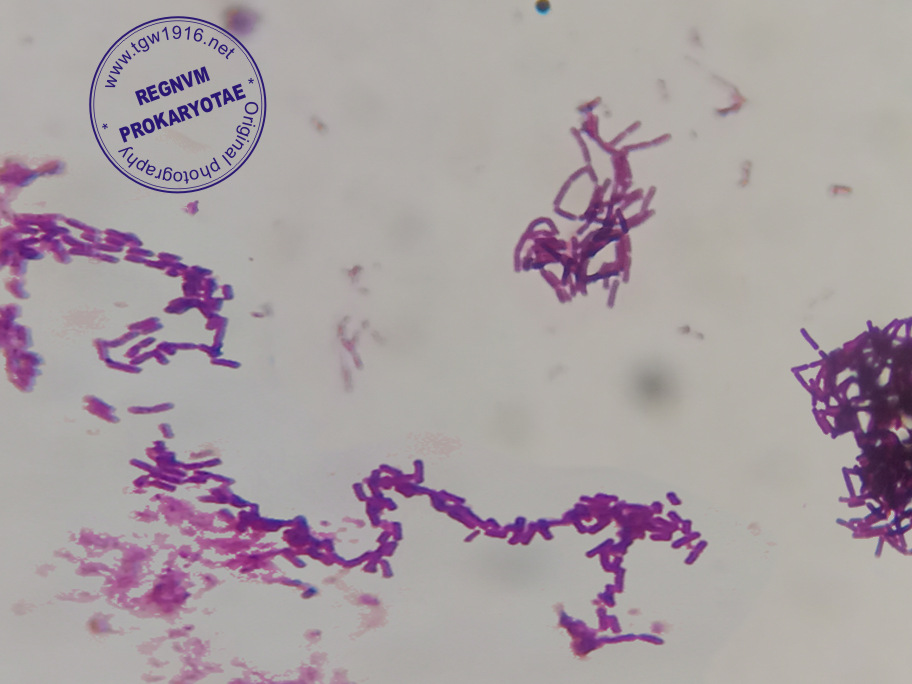
| Bacillus velezensis Gram-staining |
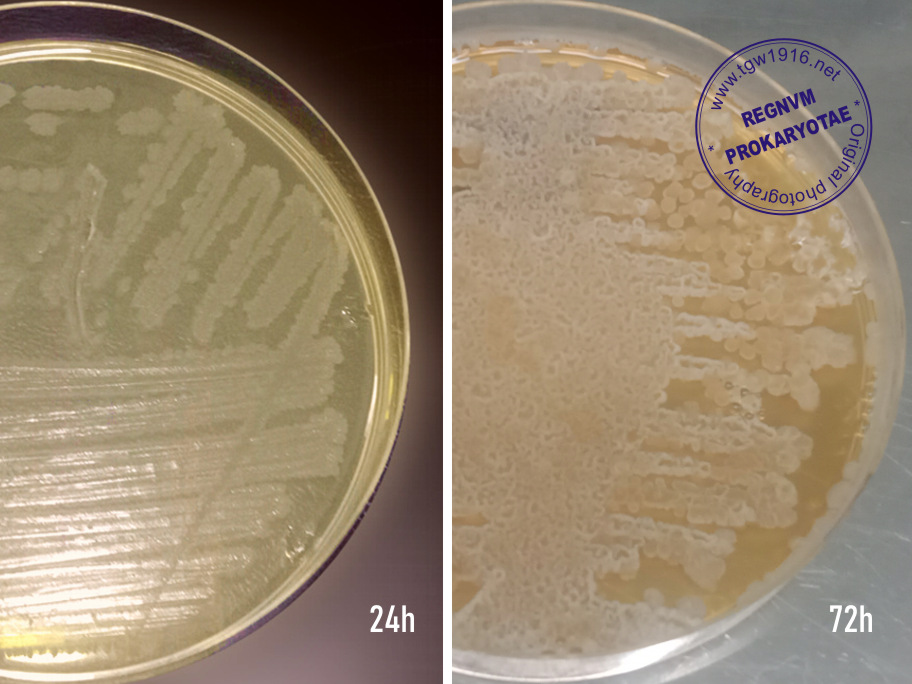
| Bacillus velezensis colonies on TSA |
| Bacillus velezensis |
Taxonomy
Morphology
Cultural characteristics
Biochemical characters
Ecology
Pathogenicity
References
Phylum Bacillota (Firmicutes), Class Bacilli, Order Caryophanales, Family Bacillaceae, Genus Bacillus, Bacillus velezensis
Ruiz-García et al. 2005.
Synonyms: Bacillus methylotrophicus Madhaiyan et al. 2010, Bacillus amyloliquefaciens subsp. plantarum Borriss et al. 2011.
Ruiz-García et al. 2005.
Synonyms: Bacillus methylotrophicus Madhaiyan et al. 2010, Bacillus amyloliquefaciens subsp. plantarum Borriss et al. 2011.
Gram-positive rods, 0.5-0.6 x 1.5-3.5 µm, occurring singly, in pairs and occasionally in short chains. Paracentral or subterminal
endospores in non-swollen sporangia are produced. No parasporal crystals detected. No poly-beta-hydroxybutyric acid accumulation.
Motile by peritrichous flagella.
endospores in non-swollen sporangia are produced. No parasporal crystals detected. No poly-beta-hydroxybutyric acid accumulation.
Motile by peritrichous flagella.
Colonies on TSA medium tare creamy-white, rough, with slightly irregular edges. In
liquid TSB medium a thin film is formed at the surface whilst the rest of the medium is
uniformly cloudy, showing no strands or clumps. Temperature range for growth is
15-45 ºC, optimum temperature is 28 ºC. Grows at pH values between 5-10 and in
NaCl concentrations of up to 12% w/v (B. methylotrophicus strain up to 4% NaCl).
Aerobic, does not grow in anaerobiosis in the presence of nitrate or fumarate. Does
not require yeast extract in medium composition. No growth on lysozyme (0.001%,
w/v). Haemolytic activity / blood hydrolysis (sic!).
liquid TSB medium a thin film is formed at the surface whilst the rest of the medium is
uniformly cloudy, showing no strands or clumps. Temperature range for growth is
15-45 ºC, optimum temperature is 28 ºC. Grows at pH values between 5-10 and in
NaCl concentrations of up to 12% w/v (B. methylotrophicus strain up to 4% NaCl).
Aerobic, does not grow in anaerobiosis in the presence of nitrate or fumarate. Does
not require yeast extract in medium composition. No growth on lysozyme (0.001%,
w/v). Haemolytic activity / blood hydrolysis (sic!).
B. velezensis strain was solated from a brackish water sample taken at the mouth of the river Velez at Torredelmar, Malaga, Spain.
Susceptible to amoxicillin, amoxicillin/clavulanic acid, cephalotin, chloramphenicol, colistin, doxycycline, erythromycin, kanamycin,
nalidixic acid, nitrofurantoin, norfloxacin, novobiocin, rifampicin, trimetroprim/sulfamethoxazole and vancomycin. Resistant to
aztreonam and ceftazidime.
B. methylotrophicus strain was isolated from rice rhizosphere soil.
Susceptible to amoxicillin, amoxicillin/clavulanic acid, cephalotin, chloramphenicol, colistin, doxycycline, erythromycin, kanamycin,
nalidixic acid, nitrofurantoin, norfloxacin, novobiocin, rifampicin, trimetroprim/sulfamethoxazole and vancomycin. Resistant to
aztreonam and ceftazidime.
B. methylotrophicus strain was isolated from rice rhizosphere soil.
Undetermined.
- Ruiz-Garcia C, Bejar V, Martinez-Checa F, Llamas I, Quesada E. Bacillus velezensis sp. nov., a surfactant-producing bacterium
isolated from the river Velez in Malaga, southern Spain. Int J Syst Evol Microbiol 2005; 55:191-195. - Madhaiyan M, Poonguzhali S, Kwon SW, Sa TM. Bacillus methylotrophicus sp. nov., a methanol-utilizing, plant-growth-promoting
bacterium isolated from rice rhizosphere soil. Int J Syst Evol Microbiol 2010; 60:2490-2495. - Dunlap CA, Kim SJ, Kwon SW, Rooney AP. Bacillus velezensis is not a later heterotypic synonym of Bacillus amyloliquefaciens;
Bacillus methylotrophicus, Bacillus amyloliquefaciens subsp. plantarum and 'Bacillus oryzicola' are later heterotypic synonyms of
Bacillus velezensis based on phylogenomics. Int J Syst Evol Microbiol 2016; 66:1212-1217
Positive results for alkaline phosphatase, catalase, casein hydrolysis, esculin
hydrolysis, esterase (C4), esterase lipase (C8), alpha-glucosidase, gelatinase, H2S
production (from cysteine), nitrate reduction, naphthol-AS-BI-phosphohydrolase,
oxidase, starch hydrolysis, Vogues-Proskauera test, acid production (without gas)
from: aesculin, amygdalin, L-arabinose, arbutin, cellobiose, D-fructose, glycerol,
glycogen, inositol, lactose, maltose, mannitol, D-mannose, methyl alpha-D-glycoside,
D-raffinose, D-ribose, salicin, sorbitol, trehalose and D-xylose.
B. methylotrophicus strain can utilize as sole carbon source: D-glucose, L-arabinose,
D-mannose, D-mannitol, N-acetylglucosamine, maltose, potassium gluconate, adipic
acid, malic acid, trisodium citrate, ammonium sulfate, potassium nitrate, sodium
nitrate, ammonium chloride, L-alanine, L-glutamine, L-tryptophan, glycine,
trimethylamine, 1-aminocyclopropane-1-carboxylate, potassium cyanate and
potassium thiocyanate.
Negative results for acid phosphatase, arginine dihydrolase, cystine arylamidase,
alpha-chymotrypsin, DNase, alpha-fucosidase, alpha-galactosidase,
beta-glucuronidase, beta-glucosidase, indole production, lysine decarboxylase,
leucine arylamidase, lipase (C14), alpha-mannosidase,
N-acetyl-beta-glucosaminidase, ornithine decarboxylase, phenylalanine deaminase,
tryptophan deaminase, tyrosine hydrolysis, Tween 20 and 80 hydrolysis, trypsin,
urease, valine arylamidase, acid production from: adonitol, D-arabinose, D- and
L-arabitol, 2- and 5-ketogluconate, dulcitol, erythritol, D- or L-fucose, galactose,
beta-gentiobiose, gluconate, inulin, D-lyxose, D-melezitose, melibiose, methyl
alpha-D-mannoside, methyl beta-D-xyloside, N-acetylglucosamine, rhamnose,
L-sorbose, starch, D-tagatose, D-turanose, xylitol and L-xylose.
Variable results for citrate utilization, beta-galactosidase, lecithinase, acid production
from D-glucose and sucrose.
hydrolysis, esterase (C4), esterase lipase (C8), alpha-glucosidase, gelatinase, H2S
production (from cysteine), nitrate reduction, naphthol-AS-BI-phosphohydrolase,
oxidase, starch hydrolysis, Vogues-Proskauera test, acid production (without gas)
from: aesculin, amygdalin, L-arabinose, arbutin, cellobiose, D-fructose, glycerol,
glycogen, inositol, lactose, maltose, mannitol, D-mannose, methyl alpha-D-glycoside,
D-raffinose, D-ribose, salicin, sorbitol, trehalose and D-xylose.
B. methylotrophicus strain can utilize as sole carbon source: D-glucose, L-arabinose,
D-mannose, D-mannitol, N-acetylglucosamine, maltose, potassium gluconate, adipic
acid, malic acid, trisodium citrate, ammonium sulfate, potassium nitrate, sodium
nitrate, ammonium chloride, L-alanine, L-glutamine, L-tryptophan, glycine,
trimethylamine, 1-aminocyclopropane-1-carboxylate, potassium cyanate and
potassium thiocyanate.
Negative results for acid phosphatase, arginine dihydrolase, cystine arylamidase,
alpha-chymotrypsin, DNase, alpha-fucosidase, alpha-galactosidase,
beta-glucuronidase, beta-glucosidase, indole production, lysine decarboxylase,
leucine arylamidase, lipase (C14), alpha-mannosidase,
N-acetyl-beta-glucosaminidase, ornithine decarboxylase, phenylalanine deaminase,
tryptophan deaminase, tyrosine hydrolysis, Tween 20 and 80 hydrolysis, trypsin,
urease, valine arylamidase, acid production from: adonitol, D-arabinose, D- and
L-arabitol, 2- and 5-ketogluconate, dulcitol, erythritol, D- or L-fucose, galactose,
beta-gentiobiose, gluconate, inulin, D-lyxose, D-melezitose, melibiose, methyl
alpha-D-mannoside, methyl beta-D-xyloside, N-acetylglucosamine, rhamnose,
L-sorbose, starch, D-tagatose, D-turanose, xylitol and L-xylose.
Variable results for citrate utilization, beta-galactosidase, lecithinase, acid production
from D-glucose and sucrose.
(c) Costin Stoica



| Back |