
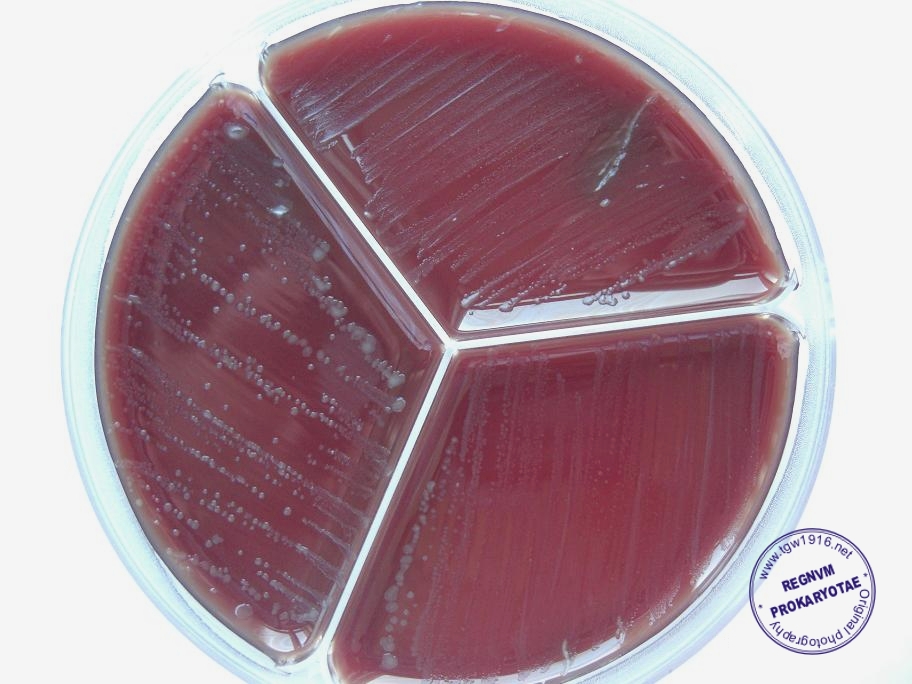
| Campylobacter jejuni colonies on Sheep Blod Agar |
| Campylobacter jejuni |
Taxonomy
Morphology
Cultural characteristics
Biochemical characters
Ecology
Pathogenicity
References
Phylum Pseudomonadota (Proteobacteria), Class Epsilonproteobacteria, Order Campylobacterales, Family Campylobacteraceae,
Genus Campylobacter,
- Campylobacter jejuni subsp. jejuni (Jones et al. 1931) Steele and Owen 1988,
- Campylobacter jejuni subsp. doylei Steele and Owen 1988.
Genus Campylobacter,
- Campylobacter jejuni subsp. jejuni (Jones et al. 1931) Steele and Owen 1988,
- Campylobacter jejuni subsp. doylei Steele and Owen 1988.
Gram-negative, S-shaped cells or tightly coiled spirals, 0.2-0.5 x 1.2-2.5 μm. Coccoid
forms results in old cultures or when exposed to oxygen. Motile by means of a single
polar flagellum (at one or both ends of the cell).
forms results in old cultures or when exposed to oxygen. Motile by means of a single
polar flagellum (at one or both ends of the cell).
Colonies may be low, flat, grayish, finely granular, and translucent appearance with
an irregular edge, and a tendency to swarm and coalesce or may be round, 1-2 mm
diameter, raised, convex, smooth, shiny, with an entire, translucent edge and a
darker, opaque center.
Usually weakly alpha-hemolytic on blood agar. Optimal growth temperature is 35-37
ºC; no growth at 25 ºC or less, but may grow poorly at 42 ºC. No growth in the
presence of 2% NaCl.
Subsp. jejuni can grow in media containing 1.0-1.5% ox-bile and 0.02% safranin.
Reduction and tolerance of 0.04% triphenyl-tetrazolium chloride is observed
in 90% of strains. Most strains grow in the presence of 100 mg/l 5-fluorouracil
and 32 mg/l cephalothin.
Subsp doylei doesn't grow on solid media containing 0.02% safranin or 32 mg/l
cephalothin. Reduction of, and tolerance to, 0.04% triphenyl-tetrazolium chloride is
variable.
an irregular edge, and a tendency to swarm and coalesce or may be round, 1-2 mm
diameter, raised, convex, smooth, shiny, with an entire, translucent edge and a
darker, opaque center.
Usually weakly alpha-hemolytic on blood agar. Optimal growth temperature is 35-37
ºC; no growth at 25 ºC or less, but may grow poorly at 42 ºC. No growth in the
presence of 2% NaCl.
Subsp. jejuni can grow in media containing 1.0-1.5% ox-bile and 0.02% safranin.
Reduction and tolerance of 0.04% triphenyl-tetrazolium chloride is observed
in 90% of strains. Most strains grow in the presence of 100 mg/l 5-fluorouracil
and 32 mg/l cephalothin.
Subsp doylei doesn't grow on solid media containing 0.02% safranin or 32 mg/l
cephalothin. Reduction of, and tolerance to, 0.04% triphenyl-tetrazolium chloride is
variable.
Subsp. jejuni was isolated from clinical specimens from humans and animals, also from normal intestinal flora of poultry and other
bird species, cattle, sheep, pigs, goats, dogs, rabbits, and monkeys.
Subsp. doylei was isolated from human clinical specimens (gastric epithelium biopsies and feces).
bird species, cattle, sheep, pigs, goats, dogs, rabbits, and monkeys.
Subsp. doylei was isolated from human clinical specimens (gastric epithelium biopsies and feces).
Flagellum seems to be an important virulence factor, necessary for colonization of the intestinal tract. Phase and antigenic variation of
the flagellar protein may serve as a means of evading the immunogenic response of the host.
Subsp. jejuni causes abortion in sheep, cattle and goats. May cause diarrhea in animals and has been associated with hepatitis in
some bird species. In humans it is a common cause of bacterial gastroenteritis; it also causes septicemia and abortion.
Subsp. doylei has been isolated from ulcerated gastric tissue, diarrhea, and blood cultures of humans, mostly infants. Pathogenicity
is undetermined.
the flagellar protein may serve as a means of evading the immunogenic response of the host.
Subsp. jejuni causes abortion in sheep, cattle and goats. May cause diarrhea in animals and has been associated with hepatitis in
some bird species. In humans it is a common cause of bacterial gastroenteritis; it also causes septicemia and abortion.
Subsp. doylei has been isolated from ulcerated gastric tissue, diarrhea, and blood cultures of humans, mostly infants. Pathogenicity
is undetermined.
- Don J. Brenner and J.J. Farmer III, 2001. Family I. Campylobacteraceae. In: Bergey’s Manual of Systematic Bacteriology, Second
edition,Vol 2, part C, George M. Garrity (Editor-in-Chief), pp 1145-1168. - T. W. Steele andR. J. Owen. NOTES: Campylobacter jejuni subsp. doylei subsp. nov., a Subspecies of Nitrate-Negative
Campylobacters Isolated from Human Clinical Specimens. Int J Syst Bacteriol July 1988 38:316-318. - M. B. Skirrow, J. Benjamin. Differentiation of enteropathogenic Campylobacter. J Clin Pathol 1980; 33:1122.
Positive results for catalase, indoxyl acetate hydrolysis, nitrate reduction (not subsp.
doylei), hippurate hydrolysis, selenite reduction (not subsp. doylei) and oxidase.
Negative results for urease and H2S production on TSI (subsp. jejuni biotype 2 is positive in iron media). No carbohydrates
fermentation.
C. jejuni subsp. doylei can be distinguished from C. jejuni subsp. jejuni by its inability to reduce nitrate and selenite; and from most
other campylobacters by its ability to hydrolyze hippurate.
doylei), hippurate hydrolysis, selenite reduction (not subsp. doylei) and oxidase.
Negative results for urease and H2S production on TSI (subsp. jejuni biotype 2 is positive in iron media). No carbohydrates
fermentation.
C. jejuni subsp. doylei can be distinguished from C. jejuni subsp. jejuni by its inability to reduce nitrate and selenite; and from most
other campylobacters by its ability to hydrolyze hippurate.
(c) Costin Stoica



| Back |