
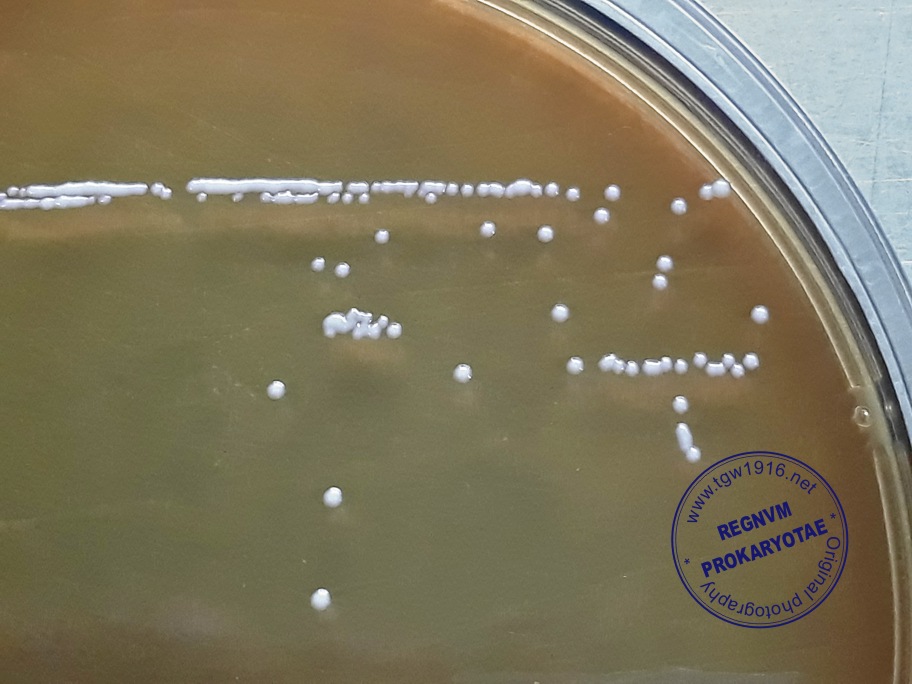
| Lactobacillus rhamnosus colonies on MRS agar after 48h incubation at 37 ºC |
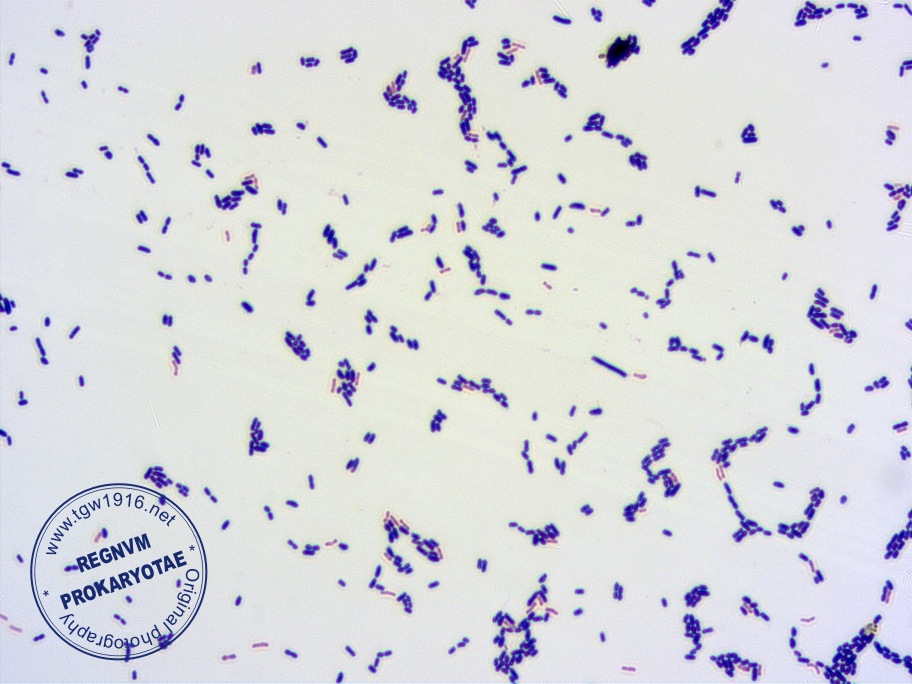
| Lactobacillus rhamnosus Gram-stained cells |
| Lactobacillus (Lacticaseibacillus) rhamnosus |
Taxonomy
Morphology
Cultural characteristics
Biochemical characters
Ecology
Pathogenicity
References
Phylum Bacillota (Firmicutes), Class Bacilli, Order Lactobacillales, Family Lactobacillaceae, Genus Lactobacillus, [Group B lactobacilli
(facultatively heterofermentative), unique phylogenetic-group], Lactobacillus rhamnosus (Hansen 1968) Collins, Phillips and Zanoni
1989.
Homotypic synonym: Lacticaseibacillus rhamnosus (Hansen 1968) Zheng et al. 2020.
Hystorical synonym: Lactobacillus casei subsp. rhamnosus Hansen 1968.
(facultatively heterofermentative), unique phylogenetic-group], Lactobacillus rhamnosus (Hansen 1968) Collins, Phillips and Zanoni
1989.
Homotypic synonym: Lacticaseibacillus rhamnosus (Hansen 1968) Zheng et al. 2020.
Hystorical synonym: Lactobacillus casei subsp. rhamnosus Hansen 1968.
Rods, 0.8-1.0 x 2.0-4.0 µm, often with square ends, occurring singly or in chains.
Nonmotile.
Nonmotile.
Can grow at 15 and 45 ºC; variable growth at 10 or 48 ºC. Grows at pH 4.0-8.5. No
growth in 8.0% NaCl.
growth in 8.0% NaCl.
Isolated from dairy products, sewage, humans (intestines), and clinical source.
Undetermined.
- Hammes W.P. and Hertel C., 2009. Genus I. Lactobacillus Beijerinck 1901. In: (Eds.) P.D. Vos, G. Garrity, D. Jones, N.R. Krieg, W.
Ludwig, F.A. Rainey, K.-H. Schleifer, W.B. Whitman. Bergey’s Manual of Systematic Bacteriology, Volume 3: The Firmicutes,
Springer, 465-511. - Collins M., Phillips B.A. and Zanoni P., 1989. Deoxyribonucleic Acid Homology Studies of Lactobacillus casei, Lactobacillus
paracasei sp. nov., subsp. paracasei and subsp. tolerans, and Lactobacillus rhamnosus sp. nov., comb. nov. IJSB Vol. 39, No.2,
105-108. - Zheng J, Wittouck S, Salvetti E, Franz MAP et al., 2020. A taxonomic note on the genus Lactobacillus: Description of 23 novel
genera, emended description of the genus Lactobacillus Beijerinck 1901, and union of Lactobacillaceae and Leuconostocaceae.
Int J Syst Microbiol. 70, 2782-2858. - Huang CH, Liou JS, Lee AY, Tseng M, Miyashita M, Huang L and Watanabe K, 2018. Polyphasic characterization of a novel
species in the Lactobacillus casei group from cow manure of Taiwan: Description of L. chiayiensis sp. nov. Syst Appl Microbiol 41
(4), 270-278.
Facultatively heterofermentative (hexoses are fermented almost exclusively to lactic
acid by the Embden-Meyerhof pathway or, at least by some species, to lactic acid,
acetic acid, ethanol, and formic acid under glucose limitations.
Pentoses are fermented to lactic and acetic acid via an inducible phosphoketolase).
Positive results for aesculin hydrolysis, alpha-fucosidase,
N-acetyl-beta-glucosaminidase, alpha- and beta-glucosidase, beta-galactosidase,
beta-glucuronidase, fermentation of: N-acetylglucosamine, amygdalin, arbutin,
cellobiose, esculin, fructose, galactose, glucose (acid production), gluconate,
beta-gentiobiose, inositol (weak reaction) lactose, maltose, mannitol, mannose,
melezitose, rhamnose, ribose, salicin, sorbitol, sucrose, tagatose, trehalose, methyl
alpha-D-glucopyranoside.
Negative results for arginine hydrolysis (NH3 production), alpha-galactosidase, nitrate
reduction, urease, fermentation of: adonitol, D- or L-arabinose, D- or L-arabitol,
erythritol, fucose, glycogen, 2- and 5-ketogluconate, inulin, methyl
alpha-D-mannopyranoside, melibiose, raffinose, starch, xylitol, D- or L-xylose.
Catalase- and oxidase- negative (admin note).
Variable results for fermentation of: dulcitol, glycerol (weak reaction), D-lyxose (weak
reaction), sorbose, and turanose.
acid by the Embden-Meyerhof pathway or, at least by some species, to lactic acid,
acetic acid, ethanol, and formic acid under glucose limitations.
Pentoses are fermented to lactic and acetic acid via an inducible phosphoketolase).
Positive results for aesculin hydrolysis, alpha-fucosidase,
N-acetyl-beta-glucosaminidase, alpha- and beta-glucosidase, beta-galactosidase,
beta-glucuronidase, fermentation of: N-acetylglucosamine, amygdalin, arbutin,
cellobiose, esculin, fructose, galactose, glucose (acid production), gluconate,
beta-gentiobiose, inositol (weak reaction) lactose, maltose, mannitol, mannose,
melezitose, rhamnose, ribose, salicin, sorbitol, sucrose, tagatose, trehalose, methyl
alpha-D-glucopyranoside.
Negative results for arginine hydrolysis (NH3 production), alpha-galactosidase, nitrate
reduction, urease, fermentation of: adonitol, D- or L-arabinose, D- or L-arabitol,
erythritol, fucose, glycogen, 2- and 5-ketogluconate, inulin, methyl
alpha-D-mannopyranoside, melibiose, raffinose, starch, xylitol, D- or L-xylose.
Catalase- and oxidase- negative (admin note).
Variable results for fermentation of: dulcitol, glycerol (weak reaction), D-lyxose (weak
reaction), sorbose, and turanose.
(c) Costin Stoica



| Back |