
| Actinobacillus pleuropneumoniae |
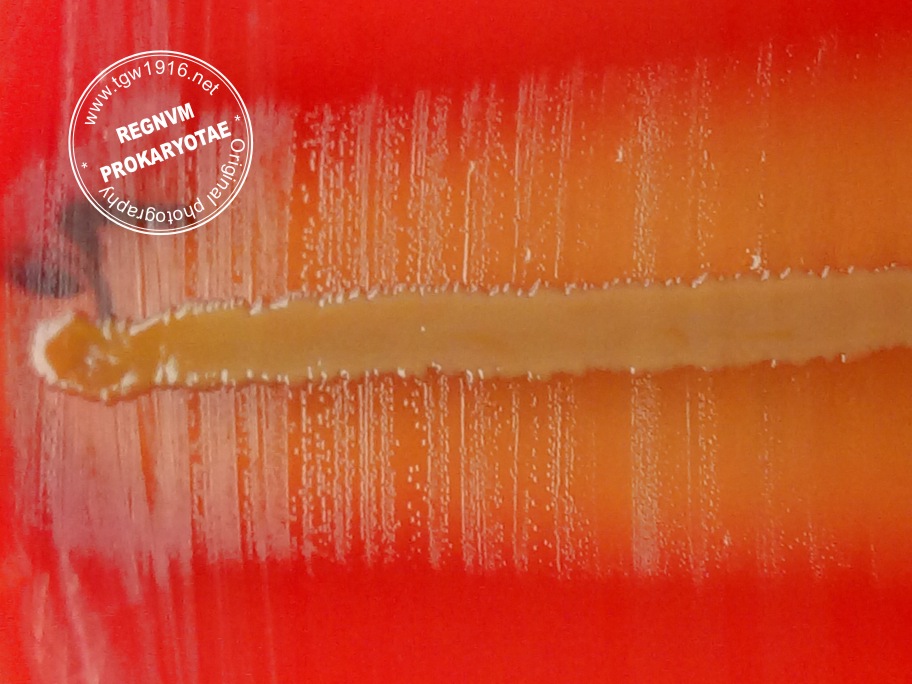
| Actinobacillus pleuropneumoniae (pinpoint colonies) dependent of V factor (NAD) - producing Staphylococcus aureus (yellow line) |
Taxonomy
Morphology
Cultural characteristics
Biochemical characters
Ecology
Pathogenicity
References
Phylum Pseudomonadota (Proteobacteria), Class Gammaproteobacteria, Order Pasteurellales, Family Pasteurellaceae, Genus
Actinobacillus, Actinobacillus pleuropneumoniae Pohl, Bertschinger, Frederiksen and Mannheim 1983.
Biovar 1 (V-factor-dependent strains previously classified as H. pleuropneumoniae; 14 serovars) & Biovar 2 (V-factor-independent
strains).
Synonyms: Haemophilus pleuropneumoniae Shope 1964.
Actinobacillus, Actinobacillus pleuropneumoniae Pohl, Bertschinger, Frederiksen and Mannheim 1983.
Biovar 1 (V-factor-dependent strains previously classified as H. pleuropneumoniae; 14 serovars) & Biovar 2 (V-factor-independent
strains).
Synonyms: Haemophilus pleuropneumoniae Shope 1964.
Gram-negative cells, nonmotile, nonspore-forming, small, coccoid to rod-shaped,
occurring singly, in pairs, or in short chains.
occurring singly, in pairs, or in short chains.
Colonies are grayish white and smooth on chocolate agar; 3 mm in diameter after 48
hours in candle jar at 37 ºC.
Beta hemolysis, but may be very slight or absent. CAMP test is positive.
V-factor dependency is variable ( Biovar 1 (V-factor-dependent strains previously
classified as H. pleuropneumoniae) and Biovar 2 (V-factor-independent strains)).
Aerobic, microaerophilic in primary isolation , facultatively anaerobic; no additional
CO2 is required for growth in subculture.
Mesophilic. Chemoorganotrophic , with pronounced growth response to fermentable
carbohydrates in peptone media. Growth on MacConkey agar is negative.
hours in candle jar at 37 ºC.
Beta hemolysis, but may be very slight or absent. CAMP test is positive.
V-factor dependency is variable ( Biovar 1 (V-factor-dependent strains previously
classified as H. pleuropneumoniae) and Biovar 2 (V-factor-independent strains)).
Aerobic, microaerophilic in primary isolation , facultatively anaerobic; no additional
CO2 is required for growth in subculture.
Mesophilic. Chemoorganotrophic , with pronounced growth response to fermentable
carbohydrates in peptone media. Growth on MacConkey agar is negative.
Isolated from pigs.
Most efficient antibiotics against A. pleuropneumoniae strains isolated from diseased piglets in Romania were ampicillin, amoxicillin
and gentamicin (100% of the tested strains were susceptible to this antibiotics).
Most efficient antibiotics against A. pleuropneumoniae strains isolated from diseased piglets in Romania were ampicillin, amoxicillin
and gentamicin (100% of the tested strains were susceptible to this antibiotics).
Biovar 1 causes the porcine pleuropneumonia, a highly contagious respiratory infection. This severe and often fatal (fibrinous)
hemorrhagic bronchopneumonia leds to significant economic losses.
A. pleuropneumoniae produces three RTX toxins (Apx I,II,III), transferrin-binding proteins and urease. Other virulence factors: capsular
polysaccharide, cellular lipopolysaccharide and outer membrane proteins.
hemorrhagic bronchopneumonia leds to significant economic losses.
A. pleuropneumoniae produces three RTX toxins (Apx I,II,III), transferrin-binding proteins and urease. Other virulence factors: capsular
polysaccharide, cellular lipopolysaccharide and outer membrane proteins.
- Olsen I., MØller K., 2004. Genus II. Actinobacillus. In: Bergey’s Manual of Systematic Bacteriology, Second edition, Vol two, part B,
George M. Garrity (Editor-in-Chief), pp. 866-883. - W.M. Janda, R. Mutters, 2006. Pasteurella, Mannheimia, Actinobacillus, Eikenella, Kingella, Capnocytophaga, and other
miscellaneous Gram-negative rods. In: Topley & Wilson’s Microbiology and Microbial Infections, 10 edition, Vol. 2, Bacteriology,
Edward Arnold Ltd. - J. G. Holt et al., 1994. Facultatively Anaerobic Gram-Negative Rods. Subgroup 3. Family Pasteurellaceae. In: Begey’s Manual of
Determinative Bacteriology, 9th-edition, Williams & Wilkins, pp 194-196. - Sorescu I., 2002, Pleuropneumonia infectioasa a porcului: date recente privind etiopatogeneza si imunoprofilaxia. Buletin
informativ in patologie porcina, V, 1, 48-50. - Sorescu I., Stoica C., Drăghici D.,Stănuică D., 2001. Sensibilitatea la antibiotice si chimioterapice a tulpinilor de E. coli,
Salmonella choleraesuis grup C, Pasteurella multocida si Actinobacillus pleuropneumoniae izolate de la porcine in intervalul
aprilie 2001 - septembrie 2001. Buletin informativ in patologie porcina, IV, 1, 23-27. - Sorescu I., Stănuică D., Luminiţa Romaşcu, Vyan Zangana, 2002. Sensibilitatea la antibiotice şi chimioterapice a tulpinilor de
Escherichia coli, Salmonella choleraesuis grup C, Pasteurella multocida, Mannheimia spp. (Pasteurella haemolytica),
Actinobacillus pleuropneumoniae, Haemophilus parasuis şi Streptococcus spp. izolate de la porcine în intervalul Ian-Oct 2002,
Buletin informativ in patologie porcina, V, 4, 3-8. - Turni C, Wu Y, Omaleki L, Giang N, Blackall PJ, Christensen H. Glaesserella australis sp. nov., isolated from the lungs of pigs. Int
J Syst Evol Microbiol 2020; 70:3686-3692. - Bisgaard M, Christensen H. Classification of avian haemolytic Actinobacillus-like organisms (Bisgaard taxon 26) associated with
anseriforme birds as Actinobacillus anseriformium sp. nov. Int J Syst Evol Microbiol 2012; 62:352-358.
Positive results for nitrates reduction, alkaline phosphatase, H2S production, ONPG,
acid production from: D(+) xylose, mannitol, D(-) fructose, urease, D(+) galactose,
D(+) mannose, maltose, sucrose and D(+) glucose (without gas).
Negative results for alpha-glucosidase, Voges-Proskauer reaction, arginine
dehydrolase, lysine decarboxylase, ornithine decarboxylase, indole production, acid
production from: glycerol, L(+) arabinose, dulcitol, meso-inositol, D(-) sorbitol, L(+)
rhamnose, L(-) sorbose, cellobiose, melibiose, trehalose, inulin, esculin and salicin.
Variable results for oxidase, catalase, acid production from: D(-) arabinose, L(-)
fucose, lactose and raffinose.
acid production from: D(+) xylose, mannitol, D(-) fructose, urease, D(+) galactose,
D(+) mannose, maltose, sucrose and D(+) glucose (without gas).
Negative results for alpha-glucosidase, Voges-Proskauer reaction, arginine
dehydrolase, lysine decarboxylase, ornithine decarboxylase, indole production, acid
production from: glycerol, L(+) arabinose, dulcitol, meso-inositol, D(-) sorbitol, L(+)
rhamnose, L(-) sorbose, cellobiose, melibiose, trehalose, inulin, esculin and salicin.
Variable results for oxidase, catalase, acid production from: D(-) arabinose, L(-)
fucose, lactose and raffinose.

(c) Costin Stoica


| Back |