
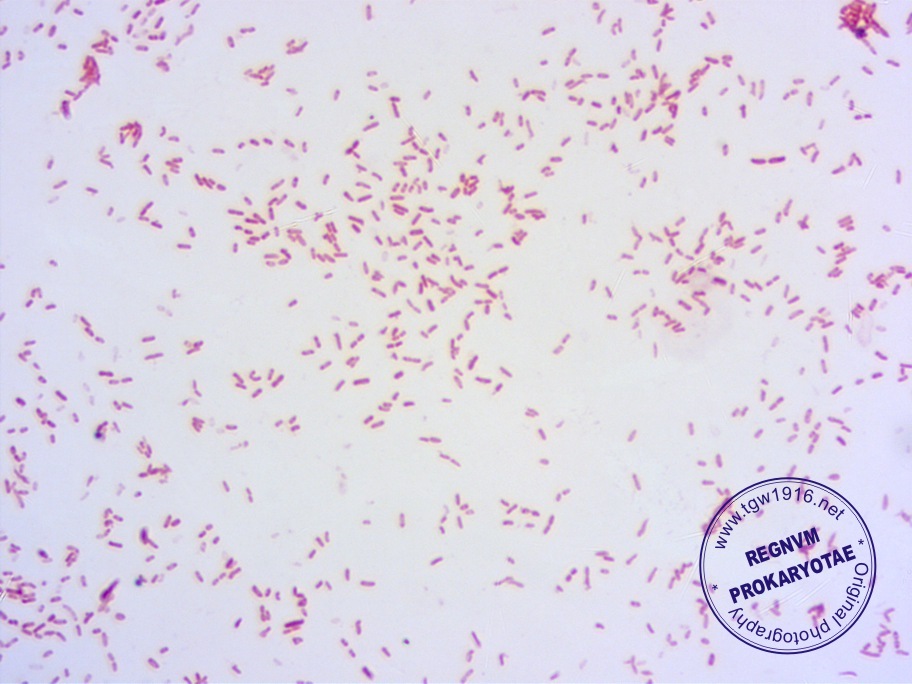
| Pseudomonas putida Gram-stained cells |
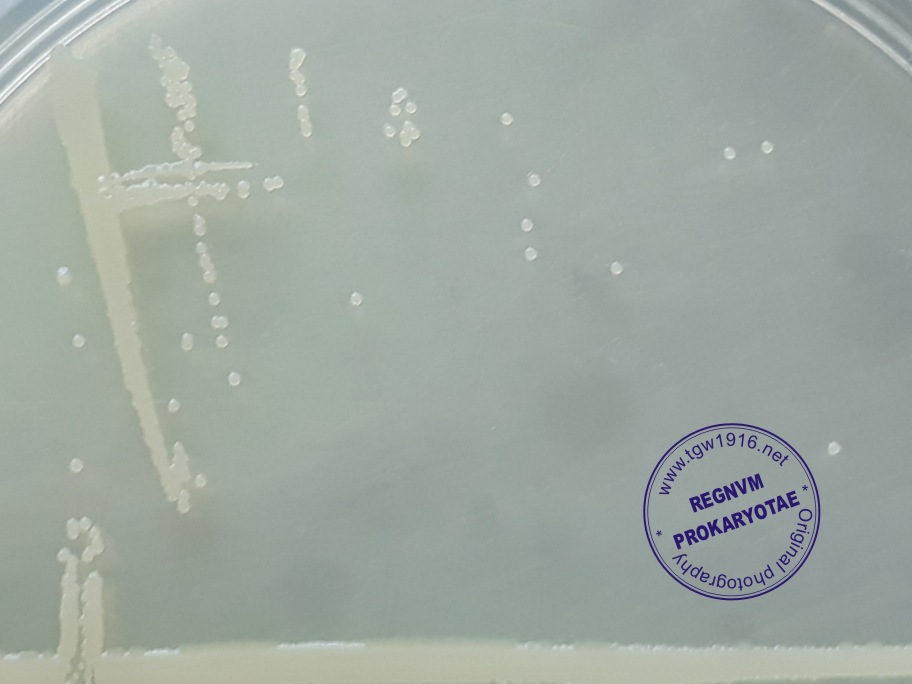
| Pseudomonas putida colonies on Mueller-Hinton agar |
| Pseudomonas putida |
Taxonomy
Morphology
Cultural characteristics
Biochemical characters
Ecology
Pathogenicity
References
Phylum Pseudomonadota (Proteobacteria), Class Gammaproteobacteria, Order Pseudomonadales, Family Pseudomonadaceae,
Genus Pseudomonas, Pseudomonas putida (Trevisan 1889) Migula 1895. Two biovars were described: A and B.
Old synonyms: Bacillus fluorescens putidus Flugge 1886, Bacillus putidus Trevisan 1889, Pseudomonas eisenbergi Migula 1900,
Pseudomonas convex Chester 1901, Pseudomonas incognita Chester 1901, Pseudomonas ovalis Chester 1901, Pseudomonas
rugosa (Wright 1895) Chester 1901, Pseudomonas striata Chester 1901.
Subjective synonym: Arthrobacter siderocapsulatus. According to Chun et al. 2001, Arthrobacter siderocapsulatus Dubinina and
Zhdanov 1975 is a later heterotypic synonym of Pseudomonas putida.
Genus Pseudomonas, Pseudomonas putida (Trevisan 1889) Migula 1895. Two biovars were described: A and B.
Old synonyms: Bacillus fluorescens putidus Flugge 1886, Bacillus putidus Trevisan 1889, Pseudomonas eisenbergi Migula 1900,
Pseudomonas convex Chester 1901, Pseudomonas incognita Chester 1901, Pseudomonas ovalis Chester 1901, Pseudomonas
rugosa (Wright 1895) Chester 1901, Pseudomonas striata Chester 1901.
Subjective synonym: Arthrobacter siderocapsulatus. According to Chun et al. 2001, Arthrobacter siderocapsulatus Dubinina and
Zhdanov 1975 is a later heterotypic synonym of Pseudomonas putida.
Gram negative, 0.7-1.1 / 2-4 μm, motile rods with polar multitrichous flagella. Some strains may have oval shape.
Cultures produce diffusible yellow to brown, green fluorescent pigment. Strictly aerobic (except in media with nitrate), optimal
temperature for growth is 25-30 ºC. No growth at 41 ºC. Some strains grow at 4 ºC. Organic growth factors not required. No growth in
media with 8.5% NaCl. Grow on media: Trypticase Soy Agar ± 5% sheep blood, Trypticase Soy Broth, Mueller-Hinton agar. Levan is
not produced.
temperature for growth is 25-30 ºC. No growth at 41 ºC. Some strains grow at 4 ºC. Organic growth factors not required. No growth in
media with 8.5% NaCl. Grow on media: Trypticase Soy Agar ± 5% sheep blood, Trypticase Soy Broth, Mueller-Hinton agar. Levan is
not produced.
Isolated from soil, water and clinical samples (rarely).
Saprophytic or opportunistic pathogen.
Septicemia and septic arthritis in immunocompromised patients were reported.
Septicemia and septic arthritis in immunocompromised patients were reported.
- Chun J., Rhee M.S., Han J.I. & Bae K.S.: Arthrobacter siderocapsulatus Dubinina and Zhdanov 1975AL is a later subjective
synonym of Pseudomonas putida (Trevisan 1889) Migula 1895AL. Int. J. Syst. Evol. Microbiol., 2001, 51, 169-170. - Elomari M., Coroloer L., Verhille S., Izard D. & Leclerc H.: Pseudomonas monteilii sp. nov., isolated from clinical specimens. Int. J.
Syst. Bacteriol., 1997, 47, 846-852. - George M. Garrity, Julia A. Bell & Timothy Lilburn: Order IX Pseudomonadales Orla-Jensen 1921 In: Bergey’s Manual of
Systematic Bacteriology, Second edition,Vol two, part B, George M. Garrity (Editor-in-Chief), 2005, pp. 323-442. - Sarah E. Burr, Stefanie Gobeli, Peter Kuhnert, Elinor Goldschmidt-Clermont, and Joachim Frey: Pseudomonas chlororaphis
subsp. piscium subsp. nov., isolated from freshwater fish. Int J Syst Evol Microbiol December 2010 60:2753-2757.
Can use more than 80 different carbon sources. Can degrade aromatic compounds
like benzene, toluene, ethylbenzenes, nitrotoluenes, chlorobenzenes, chlorophenols
etc.
Positive results for arginine dihydrolase, catalase, and oxidase.
Can utilize 2-ketogluconate (biovar A is variable), acetate, L-alanine, L-asparagine,
gamma-aminobutyrate, L-aspartate, betaine, caprate, caprylate, citrate, fumarate,
L-glutamate, glutarate, glycerol, heptanoate, beta-hydroxybutyrate, DL-lactate,
L-malate, pelargonate, L-proline, putrescine, pyruvate, succinate, cis-aconitate,
beta-alanine, L-arginine, spermine, L-tyrosine, D-alanine, L-arabinose (biovar A is
variable), benzoate (biovar A is variable), benzylamine (biovar A is variable), butanol,
butylamine, butyrate, caproate, D-fructose, D-glucose, gluconate, glycerate (biovar A is
variable), p-hydroxybenzoate, glycine (biovar A is variable), histamine (biovar A is
variable), L-histidine, L-isoleucine, L-valine, isovalerate, alpha-ketoglutarate,
L-leucine, L-lysine (biovar A is variable), malonate (biovar A is variable), mucate
(biovar A is variable), nicotinate (biovar A is variable), L-ornithine, phenylacetate
(biovar A is variable), L-phenylalanine, propionate, quinate, saccharate, sarcosine,
trigonelline (biovar A is variable), tryptamine (biovar A is variable), and valerate.
Negative results for egg-yolk reaction, nitrates reduction (positive in other studies),
gelatin hydrolysis, indole production, urease, beta galactosidase, beta-glucosidase,
and starch hydrolysis.
Cannot utilize trehalose, meso-inositol, geraniol, ethylene glycol, propylene glycol,
adipate (biovar B is variable), adonitol, azelate, cellobiose, ethylene glycole, D-fucose,
inulin, isopropanole, lactose, maleate, maltose, methanole, oxalate, phtalate,
poly-beta-hydroxybutyrate, salicin, starch, L-threonine, citraconate (biovar B is
variable), dodecane, hexadecane, erythritol, D-galactose (biovar B is variable),
glycolate (biovar A is variable), hydroxymethylglutarate, itaconate (biovar A is variable),
mesaconate (biovar A is variable), mannitol, D-mannose, naphthalene (biovar B is
variable), DL-norleucine, pantothenate, pimelate, suberate, L-rhamnose, sebacate
(biovar B is variable), sorbitol (biovar B is variable), sucrose (biovar B is variable), and
trehalose.
Variable results for utilization of: maltose, xylose, gamma-aminobutyrate, acetamide,
benzoylformate, 2,3-butylene glycol, L-citrulline, creatine, ethanol, propanol,
ethanolamine, hippurate, o-hydroxybenzoate, m-hydroxybenzoate, isobutanol,
isobutyrate, levulinate, D-malate, mandelate, phenol, D-ribose, L-serine, tartrate &
D-xylose.
Most P. putida strains are included in biovar A. Biovar B differs from biovar A only in
few phenotypic properties: can utilize as carbon source testosterone, L-tryptophan,
kynurenine, anthranilate, D-galactose, but not nicotinate.
Phenotypically, P. monteilii is almost similar to P. putida but can be differentiated by
assimilation of inositol, tartrate, tryptamine, D-mandelate, acetamide, D-xylose,
mannitol, and mucate.
like benzene, toluene, ethylbenzenes, nitrotoluenes, chlorobenzenes, chlorophenols
etc.
Positive results for arginine dihydrolase, catalase, and oxidase.
Can utilize 2-ketogluconate (biovar A is variable), acetate, L-alanine, L-asparagine,
gamma-aminobutyrate, L-aspartate, betaine, caprate, caprylate, citrate, fumarate,
L-glutamate, glutarate, glycerol, heptanoate, beta-hydroxybutyrate, DL-lactate,
L-malate, pelargonate, L-proline, putrescine, pyruvate, succinate, cis-aconitate,
beta-alanine, L-arginine, spermine, L-tyrosine, D-alanine, L-arabinose (biovar A is
variable), benzoate (biovar A is variable), benzylamine (biovar A is variable), butanol,
butylamine, butyrate, caproate, D-fructose, D-glucose, gluconate, glycerate (biovar A is
variable), p-hydroxybenzoate, glycine (biovar A is variable), histamine (biovar A is
variable), L-histidine, L-isoleucine, L-valine, isovalerate, alpha-ketoglutarate,
L-leucine, L-lysine (biovar A is variable), malonate (biovar A is variable), mucate
(biovar A is variable), nicotinate (biovar A is variable), L-ornithine, phenylacetate
(biovar A is variable), L-phenylalanine, propionate, quinate, saccharate, sarcosine,
trigonelline (biovar A is variable), tryptamine (biovar A is variable), and valerate.
Negative results for egg-yolk reaction, nitrates reduction (positive in other studies),
gelatin hydrolysis, indole production, urease, beta galactosidase, beta-glucosidase,
and starch hydrolysis.
Cannot utilize trehalose, meso-inositol, geraniol, ethylene glycol, propylene glycol,
adipate (biovar B is variable), adonitol, azelate, cellobiose, ethylene glycole, D-fucose,
inulin, isopropanole, lactose, maleate, maltose, methanole, oxalate, phtalate,
poly-beta-hydroxybutyrate, salicin, starch, L-threonine, citraconate (biovar B is
variable), dodecane, hexadecane, erythritol, D-galactose (biovar B is variable),
glycolate (biovar A is variable), hydroxymethylglutarate, itaconate (biovar A is variable),
mesaconate (biovar A is variable), mannitol, D-mannose, naphthalene (biovar B is
variable), DL-norleucine, pantothenate, pimelate, suberate, L-rhamnose, sebacate
(biovar B is variable), sorbitol (biovar B is variable), sucrose (biovar B is variable), and
trehalose.
Variable results for utilization of: maltose, xylose, gamma-aminobutyrate, acetamide,
benzoylformate, 2,3-butylene glycol, L-citrulline, creatine, ethanol, propanol,
ethanolamine, hippurate, o-hydroxybenzoate, m-hydroxybenzoate, isobutanol,
isobutyrate, levulinate, D-malate, mandelate, phenol, D-ribose, L-serine, tartrate &
D-xylose.
Most P. putida strains are included in biovar A. Biovar B differs from biovar A only in
few phenotypic properties: can utilize as carbon source testosterone, L-tryptophan,
kynurenine, anthranilate, D-galactose, but not nicotinate.
Phenotypically, P. monteilii is almost similar to P. putida but can be differentiated by
assimilation of inositol, tartrate, tryptamine, D-mandelate, acetamide, D-xylose,
mannitol, and mucate.

(c) Costin Stoica


| Back |