
| Staphylococcus aureus |
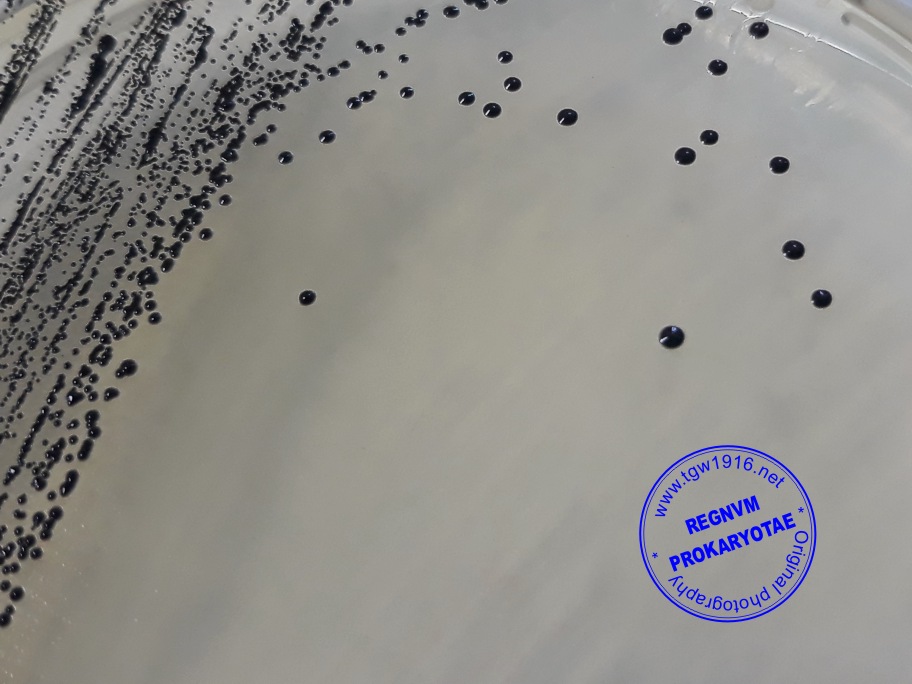
| Shiny black colonies produced on Baird-Parker agar |
Legend: + positive 90-100%, - negative 90-100%, d positive 25-74%, nd not determined.
S. aureus subsp. aureus
- arthritis in chicken, otitis in dogs, mastitis in cows / sheeps;
- may be a cause of toxic shock syndrome (toxins produced);
- deep-seated infections, such as osteomyelitis and endocarditis;
- skin lesions such as boils, styes and furunculosis, folliculitis, scalded skin
syndrome, impetigo;
- nosocomial infections;
- food poisoning by releasing enterotoxins into food (staphyloenterotoxicosis,
staphyloenterotoxemia);
- produce hyaluronidase, Protein A, coagulase, clotting factor, hemolysins (α, β, γ, δ),
leukotoxin, leukocidin, deoxyribonuclease (DNase), beta lactamase (penicillinase),
staphylokinase, enterotoxins (A, B, C, C2, D, E, F), toxic shock syndrome toxin.
- arthritis in chicken, otitis in dogs, mastitis in cows / sheeps;
- may be a cause of toxic shock syndrome (toxins produced);
- deep-seated infections, such as osteomyelitis and endocarditis;
- skin lesions such as boils, styes and furunculosis, folliculitis, scalded skin
syndrome, impetigo;
- nosocomial infections;
- food poisoning by releasing enterotoxins into food (staphyloenterotoxicosis,
staphyloenterotoxemia);
- produce hyaluronidase, Protein A, coagulase, clotting factor, hemolysins (α, β, γ, δ),
leukotoxin, leukocidin, deoxyribonuclease (DNase), beta lactamase (penicillinase),
staphylokinase, enterotoxins (A, B, C, C2, D, E, F), toxic shock syndrome toxin.
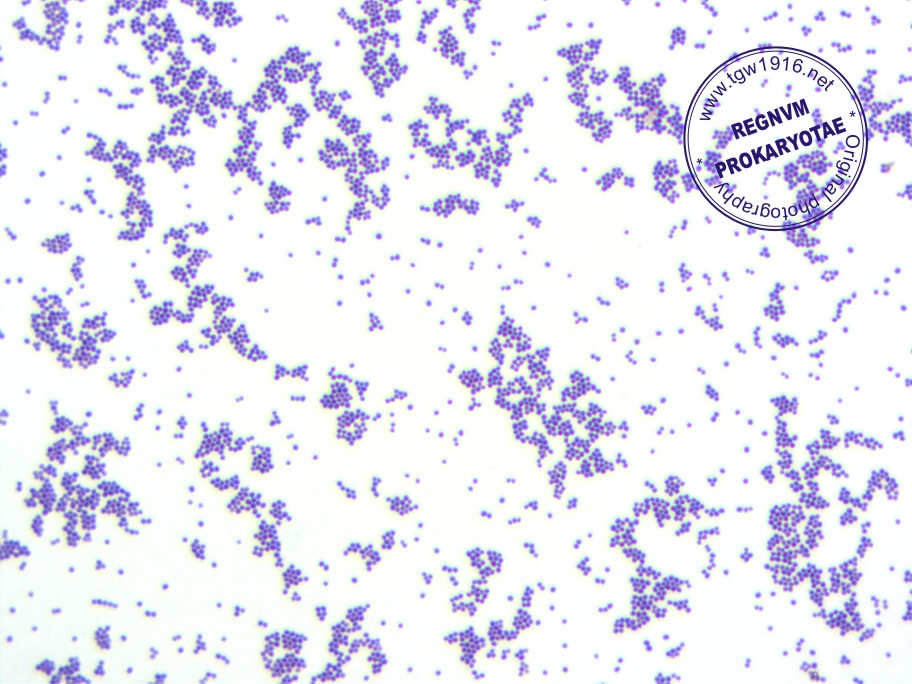
| Staphylococcus aureus, Gram-stained cells |
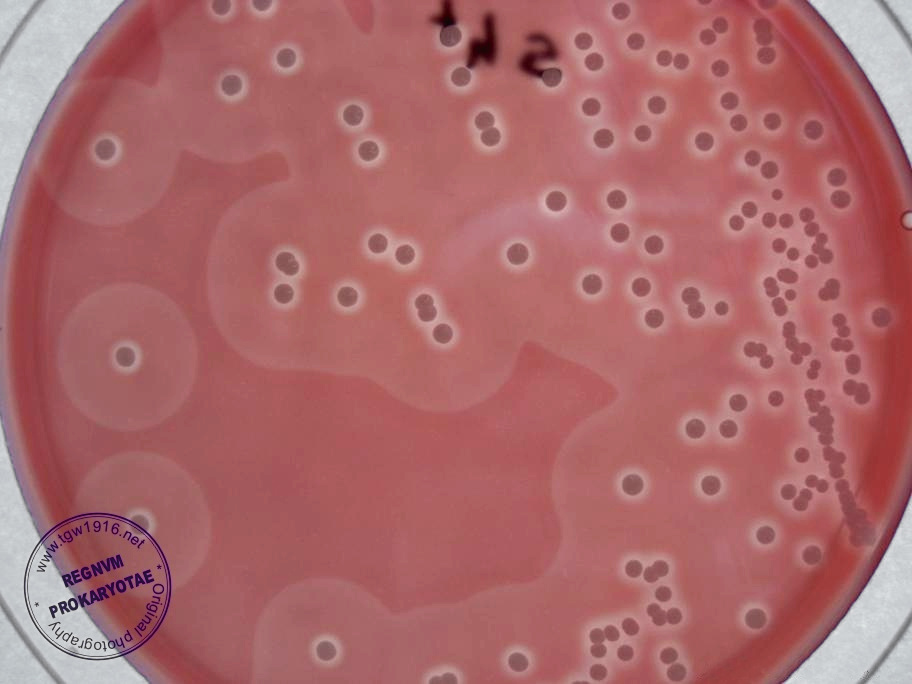
| S. aureus alpha- and beta-haemolytic colonies |
Taxonomy
Morphology
Cultural characteristics
Biochemical characters
Ecology
Pathogenicity
References
Phylum Bacillota (Firmicutes), Class Bacilli, Order Bacillales, Family Staphylococcaceae, Genus Staphylococcus, two subspecies:
- Staphylococcus aureus subsp. anaerobius De La Fuente et al. 1985,
- Staphylococcus aureus subsp. aureus Rosenbach 1884 – type species of the genus.
Old synonyms: Rosenbach 1884 (Staphylococcus pyogenes aureus); other synonims: Staphlococcus pyogenes citreus Passet
1885; Micrococcus aureus Zopf 1885; Micrococcus pyogenes Lehmann and Neumann 1896.
- Staphylococcus aureus subsp. anaerobius De La Fuente et al. 1985,
- Staphylococcus aureus subsp. aureus Rosenbach 1884 – type species of the genus.
Old synonyms: Rosenbach 1884 (Staphylococcus pyogenes aureus); other synonims: Staphlococcus pyogenes citreus Passet
1885; Micrococcus aureus Zopf 1885; Micrococcus pyogenes Lehmann and Neumann 1896.
Gram-positive cocci, 0,8-1 μm, nonmotile, nonsporing. Occur in clusters resembling
grapes (staphylo-).
grapes (staphylo-).
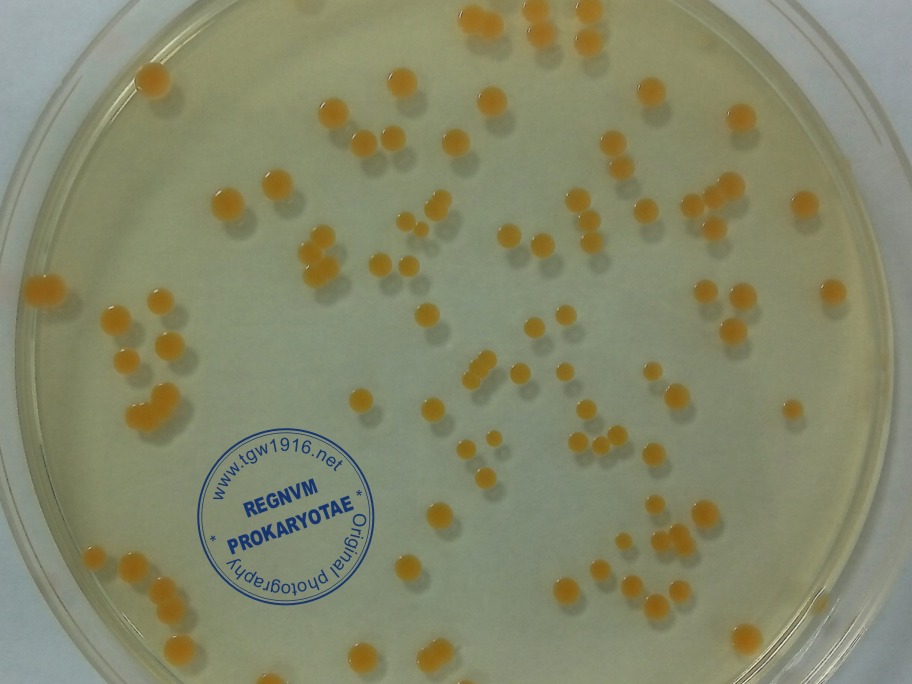
Subsp. aureus: after 48h of incubation colonies are circular, opaque, yellowish, 0.5-2
mm diameter, S-type, often hemolytic on blood agar. May produce capsules.
Encapsulated strains usually produce smaller and more convex colonies. Temperature
range for growth 10-45 ºC; optimum 30-37 ºC. Facultatively anaerobic.
Subsp. anaerobius: colonies on blood agar are white (non-pigmented), opaque,
glistening, entire, smooth, and convex; 1-3 mm in diameter after 2 days incubation.
Temperature range for optimal growth 30-40 ºC. No growth at 20 or 45 ºC.
Both subspecies grow good in medium containing 10% NaCl; poor/none at 15% NaCl.
Grow on Trypticase Soy Agar ± 5% sheep blood, Mueller Hinton agar, Dorset with egg
(for subsp. anaerobius), Chapman (selective medium with 75 g/l NaCl & mannitol),
Baird-Parker agar (selective medium with lithium chloride and potassium tellurite).
mm diameter, S-type, often hemolytic on blood agar. May produce capsules.
Encapsulated strains usually produce smaller and more convex colonies. Temperature
range for growth 10-45 ºC; optimum 30-37 ºC. Facultatively anaerobic.
Subsp. anaerobius: colonies on blood agar are white (non-pigmented), opaque,
glistening, entire, smooth, and convex; 1-3 mm in diameter after 2 days incubation.
Temperature range for optimal growth 30-40 ºC. No growth at 20 or 45 ºC.
Both subspecies grow good in medium containing 10% NaCl; poor/none at 15% NaCl.
Grow on Trypticase Soy Agar ± 5% sheep blood, Mueller Hinton agar, Dorset with egg
(for subsp. anaerobius), Chapman (selective medium with 75 g/l NaCl & mannitol),
Baird-Parker agar (selective medium with lithium chloride and potassium tellurite).
Isolated from human & animal skin, ears and mucous membranes; ubiquitous.
Novobiocin sensible.
Novobiocin sensible.
S. aureus subsp. anaerobius
- absceses in small ruminants, nonpathogenic for rodents.
- produce coagulase and hyaluronidase.
- no production of enterotoxins A, B, C, D, or E or protein A.
- absceses in small ruminants, nonpathogenic for rodents.
- produce coagulase and hyaluronidase.
- no production of enterotoxins A, B, C, D, or E or protein A.
- Holt J.G., Krieg N.R., Sneath P.H.A., Staley J.T., Wiliams S.T., 1994. Bergey's
Manual of Determinative Bacteriology, Ninth Edition, Williams & Wilkins,
Baltimore. Group 17, Gram-Positive Cocci, 527-558. - De La Fuente R., Suarez G. & Schleifer K.H.: Staphylococcus aureus subsp.
anaerobius subsp. nov., the causal agent of abscess disease of sheep. Int. J.
Syst. Bacteriol., 1985, 35, 99-102. - Rosenbach F.J.: Microorganismen bei den Wund-Infections-Krankheiten des
Menschen. J.F. Bergmann, Wiesbaden, 1884, pp. 1-122. - Karl-Heinz Schleifer and Julia A. Bell, 2009. Family VIII. Staphylococcaceae fam.
nov.. In: (Eds.) P.D. Vos, G. Garrity, D. Jones, N.R. Krieg, W. Ludwig, F.A. Rainey, K.
-H. Schleifer, W.B. Whitman. Bergey’s Manual of Systematic Bacteriology, Volume
3: The Firmicutes, Springer, 392-426.
Positive results for alkaline phosphatase, coagulase, DN-ase, FDP-aldolase class 1,
heat-stable nuclease, hyaluronidase, urease, acid production from fructose, and
sucrose.
Negative results for beta-galactosidase, beta-glucuronidase, oxidase, acid production
from arabinose, cellobiose, melezitose, raffinose, salicin, xylitol, and xylose.
Differential characters of Staphylococcus aureus subspecies:
heat-stable nuclease, hyaluronidase, urease, acid production from fructose, and
sucrose.
Negative results for beta-galactosidase, beta-glucuronidase, oxidase, acid production
from arabinose, cellobiose, melezitose, raffinose, salicin, xylitol, and xylose.
Differential characters of Staphylococcus aureus subspecies:
(c) Costin Stoica

|
|
|

| Carotenoid pigment producing colonies on Mueller-Hinton Agar after 48h incubation |

| Back |