
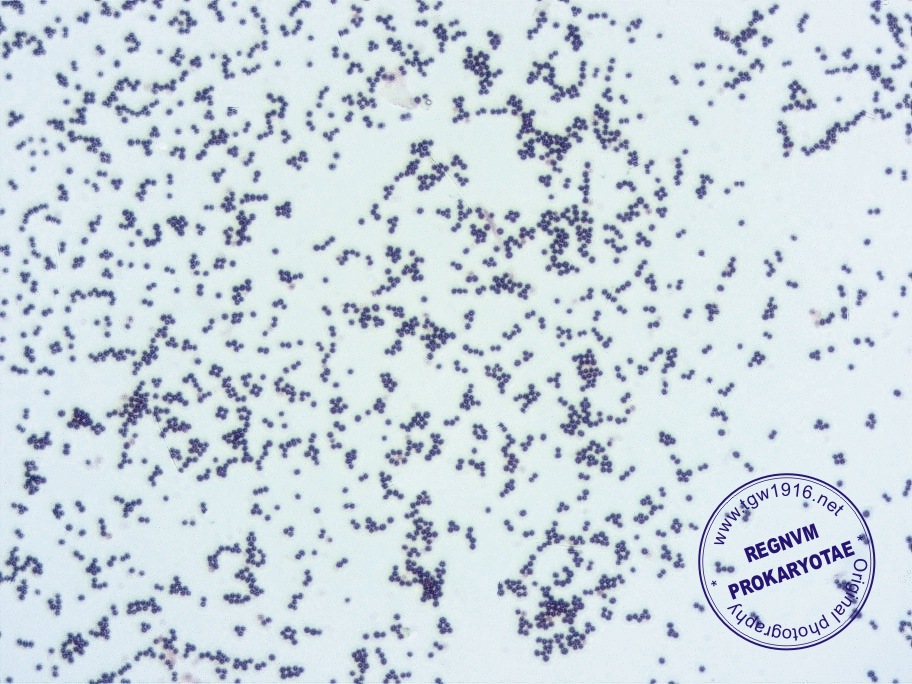
| Staphylococcus sciuri Gram-stained cells |
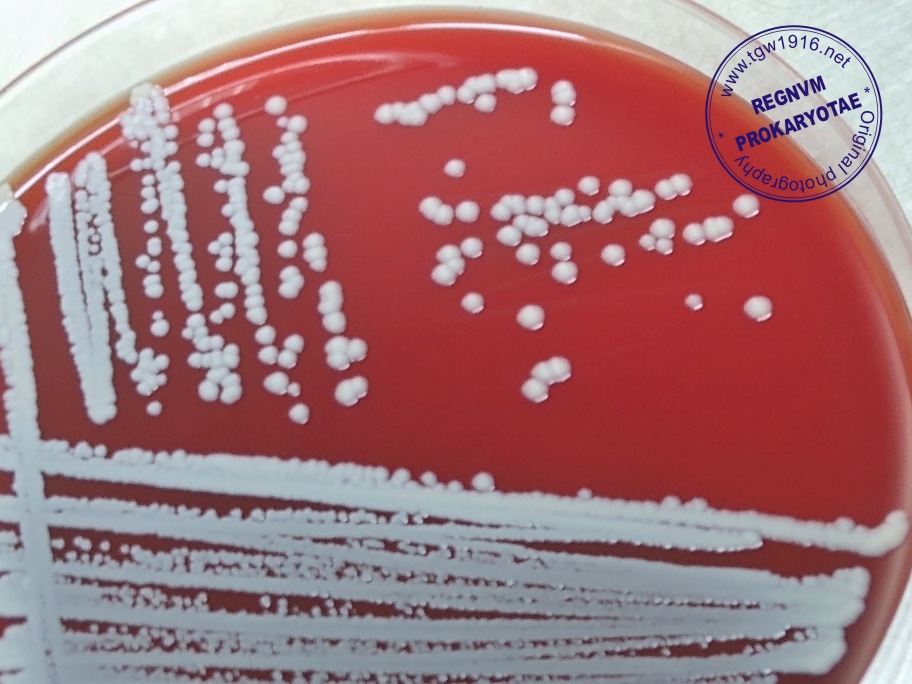
| Staphylococcus sciuri colonies on sheep blood agar |
| Staphylococcus sciuri |
Taxonomy
Morphology
Cultural characteristics
Biochemical characters
Ecology
Pathogenicity
References
Phylum Bacillota (Firmicutes), Class Bacilli, Order Bacillales, Family Staphylococcaceae, Genus Staphylococcus, Staphylococcus
sciuri Kloos et al. 1976, four subspecies:
- Staphylococcus sciuri subsp. carnaticus Kloos et al. 1997
- Staphylococcus sciuri subsp. lentus Kloos et al. 1976 - moved to Staphylococcus lentus, Schleifer et al. 1983
- Staphylococcus sciuri subsp. rodentium Kloos et al. 1997
- Staphylococcus sciuri subsp. sciuri Kloos et al. 1976.
Subspecies ‘sciuri’, ‘carnaticus’ and ‘rodentium’ were created by ribotype delineation.
sciuri Kloos et al. 1976, four subspecies:
- Staphylococcus sciuri subsp. carnaticus Kloos et al. 1997
- Staphylococcus sciuri subsp. lentus Kloos et al. 1976 - moved to Staphylococcus lentus, Schleifer et al. 1983
- Staphylococcus sciuri subsp. rodentium Kloos et al. 1997
- Staphylococcus sciuri subsp. sciuri Kloos et al. 1976.
Subspecies ‘sciuri’, ‘carnaticus’ and ‘rodentium’ were created by ribotype delineation.
Gram positive cocci, 0.7-1.2 μm diameter, nonmotile, nonsporing, occuring singly and
forming pairs and tetrads.
forming pairs and tetrads.
Colonies are circular, S-type, yellowish-gray. Facultatively anaerobic, 37 ºC (also
grows at 15 ºC). Grow better under aerobic conditions. Some strains do not grow in
the anaerobic zone of thioglycolate medium. No growth or poor growth at 45 ºC. Grow
on media: Trypticase Soy Yeast extract Agar ± 5% sheep blood, Trypticase Soy Yeast
extract Broth, Nutrient agar, P agar.
grows at 15 ºC). Grow better under aerobic conditions. Some strains do not grow in
the anaerobic zone of thioglycolate medium. No growth or poor growth at 45 ºC. Grow
on media: Trypticase Soy Yeast extract Agar ± 5% sheep blood, Trypticase Soy Yeast
extract Broth, Nutrient agar, P agar.
Isolated from soil, water, sand, animal skin (eastern gray squirrel - Sciurus
carolinensis, opossum, dog, cattle) and human clinical samples (urine). Also isolated
from cow milk (admin note).
Can grow in habitats containing only an inorganic nitrogen source and thus might be
more free-living than other staphylococci. Novobiocin and lysozyme resistant.
carolinensis, opossum, dog, cattle) and human clinical samples (urine). Also isolated
from cow milk (admin note).
Can grow in habitats containing only an inorganic nitrogen source and thus might be
more free-living than other staphylococci. Novobiocin and lysozyme resistant.
Urinary tract infection (one report), endocarditis, peritonitis, septic shock, and wound infections in humans. Doubtful pathogenicity.
S. sciuri was frequently present as a part of skin, nasal and oral flora in healthy dogs and bovines.
S. sciuri was frequently present as a part of skin, nasal and oral flora in healthy dogs and bovines.
- Holt J.G., Krieg N.R., Sneath P.H.A., Staley J.T., Wiliams S.T., 1994. Bergey's Manual of Determinative Bacteriology, Ninth Edition,
Williams & Wilkins, Baltimore. Group 17, Gram-Positive Cocci, 527-558. - Kloos W.E., Ballard D.N., Webster J.A., Hubner R.J., Tomasz A., Couto I., Sloan G.L., Dehart H.P., Fiedler F., Schubert K., De
Lencastre H., Santos SanchesS (I.), Heath H.E., Leblanc P.A. & Ljungh A.: Ribotype delineation and description of Staphylococcus
sciuri subspecies and their potential as reservoirs of methicillin resistance and staphylolytic enzyme genes. Int. J. Syst. Bacteriol.,
1997, 47, 313-323. - KloosW.E., Schleifer K.H. & Smith R.F.: Characterization of Staphylococcus sciuri sp. nov. and its subspecies. International
Journal of Systematic Bacteriology, 1976, 26, 22-37. - Srdjan Stepanovic, Petr Ježek, Dragana Vukovic, Ivana Dakic, & Petr Petrás: Isolation of Members of the Staphylococcus sciuri
Group from Urine and Their Relationship to Urinary Tract Infections. J Clin Microbiol. 2003 November; 41(11): 5262–5264. - White D.G., Harmon R.J., Matos J.E.S. & Langlois B.E.: Isolation and Identification of Coagulase-Negative Staphylococcus
Species from Bovine Body Sites and Streak Canals of Nulliparous Heifers. Department of Animal Sciences, University of Kentucky
Lexington 40546-0215. - Karl-Heinz Schleifer and Julia A. Bell, 2009. Family VIII. Staphylococcaceae fam. nov.. In: (Eds.) P.D. Vos, G. Garrity, D. Jones, N.R.
Krieg, W. Ludwig, F.A. Rainey, K.-H. Schleifer, W.B. Whitman. Bergey’s Manual of Systematic Bacteriology, Volume 3: The
Firmicutes, Springer, 392-426.
Positive results for nitrate reduction, deoxyribonuclease, benzidine test, oxidase,
beta-glucosidase, catalase, acid production from: trehalose, mannitol, sucrose,
cellobiose, fucose, glucose (many strains only ferment glucose weakly), glycerol,
galactose, dulcitol, meso-erythritol, D-erythrose, D-lyxose, L-sorbose, and tagatose.
Negative results for urease, coagulase-rabbit plasma, clumping factor,
beta-glucuronidase, beta-galactosidase, elastase, lipase, acetoin production
(Voges-Proskauer), arginine dihydrolase, acid production from: raffinose, turanose,
and xylitol.
Variable results for alkaline phosphatase, acid production from L-arabinose, lactose,
maltose, D-mannose, D-melezitose, rhamnose, salicin, D-sorbitol, and D-xylose.
S. sciuri subsp. carnaticus could be distinguished by its ability to produce acid
aerobically from D-xylose and maltose, inability to produce acid from D-melezitose.
S. sciuri subsp. rodentium could be distinguished by its positive reaction for clumping
factor and/or protein A .
beta-glucosidase, catalase, acid production from: trehalose, mannitol, sucrose,
cellobiose, fucose, glucose (many strains only ferment glucose weakly), glycerol,
galactose, dulcitol, meso-erythritol, D-erythrose, D-lyxose, L-sorbose, and tagatose.
Negative results for urease, coagulase-rabbit plasma, clumping factor,
beta-glucuronidase, beta-galactosidase, elastase, lipase, acetoin production
(Voges-Proskauer), arginine dihydrolase, acid production from: raffinose, turanose,
and xylitol.
Variable results for alkaline phosphatase, acid production from L-arabinose, lactose,
maltose, D-mannose, D-melezitose, rhamnose, salicin, D-sorbitol, and D-xylose.
S. sciuri subsp. carnaticus could be distinguished by its ability to produce acid
aerobically from D-xylose and maltose, inability to produce acid from D-melezitose.
S. sciuri subsp. rodentium could be distinguished by its positive reaction for clumping
factor and/or protein A .

(c) Costin Stoica


| Back |