
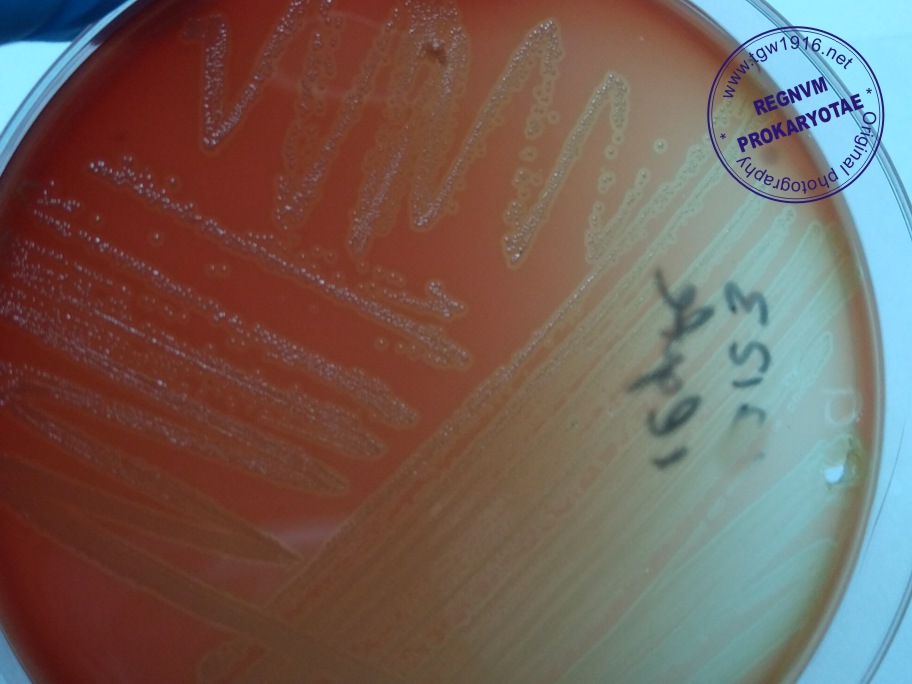
| S. pluranimalium haemolytic colonies on sheep blood agar |
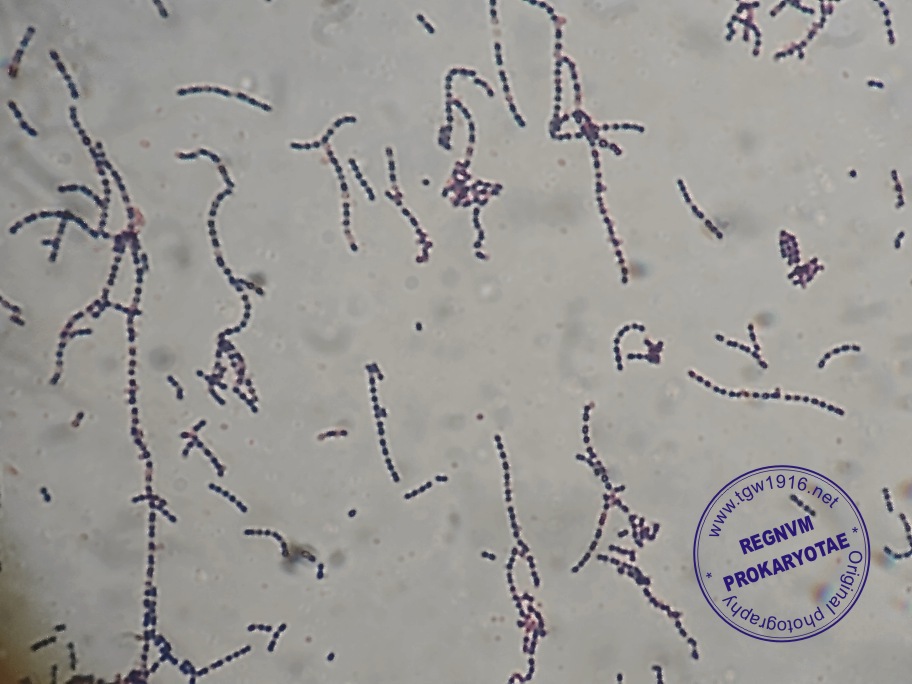
| S. pluranimalium Gram-positive chained cells |
| Streptococcus pluranimalium |
Taxonomy
Morphology
Cultural characteristics
Biochemical characters
Ecology
Pathogenicity
References
Phylum Bacillota (Firmicutes), Class Bacilli, Order Lactobacillales, Family Streptococcaceae, Genus Streptococcus, Streptococcus
pluranimalium Devriese et al. 1999.
Lancefield grouping is unknown, but one strain biochemically identified as S. pluranimalium didn't react with Lancefield groups A-G
(admin note).
pluranimalium Devriese et al. 1999.
Lancefield grouping is unknown, but one strain biochemically identified as S. pluranimalium didn't react with Lancefield groups A-G
(admin note).
Gram-positive cocci, grouped in chains or small groups. Non-motile.
Colonies are regular, transparent, non-pigmented, small, under 1 mm diameter,
alpha-hemolytic (colonies are surrounded by pronounced greening zones with
demarcated edges). One strain isolated from cow milk seems to be beta-haemolytic
(admin note). Grow at 37 and 42 ºC, no growth under 25 ºC. Most strains produce
precipitates and clear supernatants in broth. Growth media: Blood agar, Brain Heart
Infusion broth. May grow (or not) in 6.5 % NaCl broth.
alpha-hemolytic (colonies are surrounded by pronounced greening zones with
demarcated edges). One strain isolated from cow milk seems to be beta-haemolytic
(admin note). Grow at 37 and 42 ºC, no growth under 25 ºC. Most strains produce
precipitates and clear supernatants in broth. Growth media: Blood agar, Brain Heart
Infusion broth. May grow (or not) in 6.5 % NaCl broth.
Isolated from milk, genital tract and tonsils of cattle, from tonsils of a goat and a cat
and from the crop and the respiratory tract of canaries.
and from the crop and the respiratory tract of canaries.
Isolated from mastitic milk of a dairy cow.
May be a normal inhabitant of the bovine genital tract.
May be a normal inhabitant of the bovine genital tract.
- Devriese L.A., Vandamme P., Collins M.D., Alvarez N., Pot B., Hommez J., Butaye P. & Haesebrouck F.: Streptococcus
pluranimalium sp. nov., from cattle and other animals. Int. J. Syst. Bacteriol, 1999, 49, 1221-1226. - Robert A. Whiley and Jeremy M. Hardie, 2009. Genus I. Streptococcus Rosenbach 1884, 22AL. In: (Eds.) P.D. Vos, G. Garrity, D.
Jones, N.R. Krieg, W. Ludwig, F.A. Rainey, K.-H. Schleifer, W.B. Whitman. Bergey’s Manual of Systematic Bacteriology, Volume 3:
The Firmicutes, Springer, 655-711.
Strains of Streptococcus pluranimalium resemble Streptococcus acidominimus and
some reference strains of the latter have been re-identified as S. pluranimalium.
Positive results for hippurate hydrolysis, activity of leucine arylamidase,
alanine-phenylalanine-proline arylamidase, hydrolysis of 4-methylumbelliferyl
(MU)-phosphate, L-phenylalanine 7-amido-4-methyl-coumarin (AMC), L-tryptophan
AMC, acid production from: glucose, fructose, and trehalose.
Negative results for Voges-Proskauer reaction, catalase, urease, acid production
from adonitol, starch, D- and L-arabitol, D- and L-arabinose, D-cyclodextrin, 2- and
5-ketogluconate, dulcitol, erythritol, D- and L-fucose, methyl alpha-D-glucoside,
gluconate, glycogen, inositol, inulin, D-lyxose, methyl alpha-D-mannoside, pullulan,
rhamnose, L-sorbose, D-turanose, D- and L-xylose, and xylitol.
Variable results for arginine dihydrolase, pyrrolidonyl arylamidase, alpha- or beta-
galactosidase, beta-glucuronidase, beta-glucosidase, alkaline phosphatase,
N-acetyl-beta-glucosaminidase, acid production from amygdalin, arbutin, cellobiose,
beta-gentiobiose, ribose, mannitol, lactose, salicin, sorbitol, and rafinose.
some reference strains of the latter have been re-identified as S. pluranimalium.
Positive results for hippurate hydrolysis, activity of leucine arylamidase,
alanine-phenylalanine-proline arylamidase, hydrolysis of 4-methylumbelliferyl
(MU)-phosphate, L-phenylalanine 7-amido-4-methyl-coumarin (AMC), L-tryptophan
AMC, acid production from: glucose, fructose, and trehalose.
Negative results for Voges-Proskauer reaction, catalase, urease, acid production
from adonitol, starch, D- and L-arabitol, D- and L-arabinose, D-cyclodextrin, 2- and
5-ketogluconate, dulcitol, erythritol, D- and L-fucose, methyl alpha-D-glucoside,
gluconate, glycogen, inositol, inulin, D-lyxose, methyl alpha-D-mannoside, pullulan,
rhamnose, L-sorbose, D-turanose, D- and L-xylose, and xylitol.
Variable results for arginine dihydrolase, pyrrolidonyl arylamidase, alpha- or beta-
galactosidase, beta-glucuronidase, beta-glucosidase, alkaline phosphatase,
N-acetyl-beta-glucosaminidase, acid production from amygdalin, arbutin, cellobiose,
beta-gentiobiose, ribose, mannitol, lactose, salicin, sorbitol, and rafinose.

(c) Costin Stoica


| Back |