
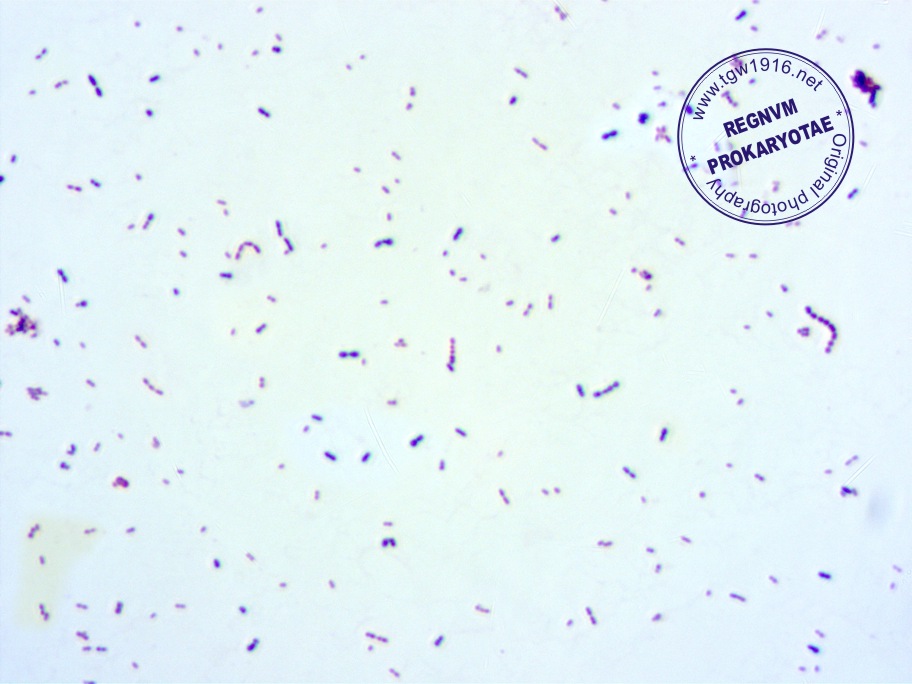
| S. pneumoniae Gram-positive, ovoid cells grouped in pairs and short chains |
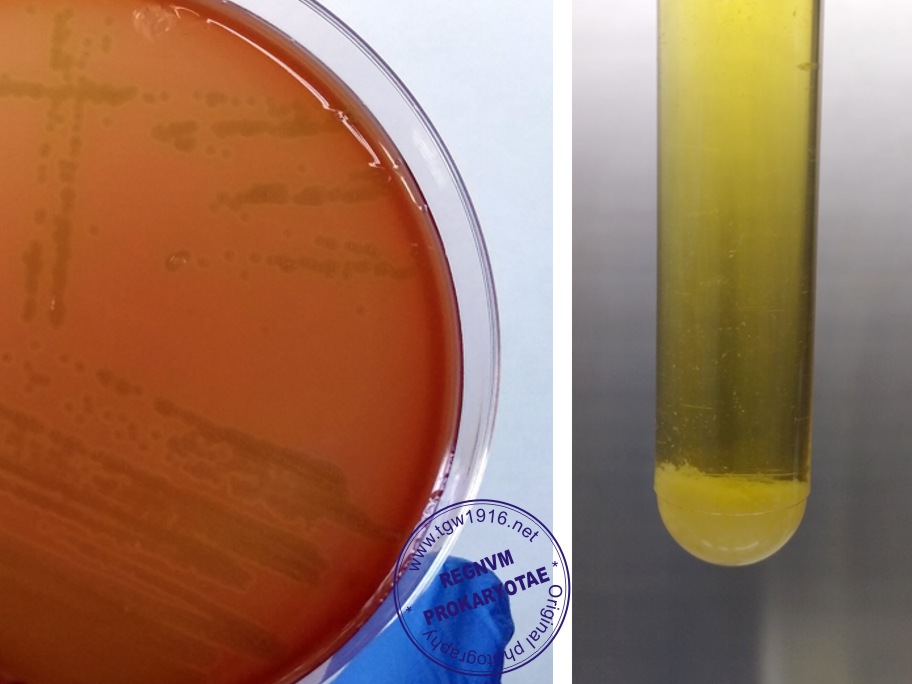
| S. pneumoniae alpha-haemolytic colonies on sheep blood agar (left) and deposit in BHI broth (right) |
| Streptococcus pneumoniae |
Taxonomy
Morphology
Cultural characteristics
Biochemical characters
Ecology
Pathogenicity
References
Phylum Bacillota (Firmicutes), Class Bacilli, Order Lactobacillales, Family Streptococcaceae, Genus Streptococcus, Streptococcus
pneumoniae (Klein 1884) Chester 1901.
Synonyms: Micrococcus pneumoniae Klein 1884, Diplococcus pneumoniae (Klein 1884) Weichselbaum 1886.
Ninety antigenically distinct capsular serotypes are recognized differing in component sugars and/or linkages.
Non-groupable by Lancefield antisera.
pneumoniae (Klein 1884) Chester 1901.
Synonyms: Micrococcus pneumoniae Klein 1884, Diplococcus pneumoniae (Klein 1884) Weichselbaum 1886.
Ninety antigenically distinct capsular serotypes are recognized differing in component sugars and/or linkages.
Non-groupable by Lancefield antisera.
Spherical to oval cocci, with pointed ends or lance shaped; 0.5-1.25 μm. Heavily
encapsulated with polysaccharide that is distinct from envelope. Gram-positive
staining; old cultures may stain Gram-negative. Grouped singly or short chains;
typically in pairs .
encapsulated with polysaccharide that is distinct from envelope. Gram-positive
staining; old cultures may stain Gram-negative. Grouped singly or short chains;
typically in pairs .
Grow at 37.0 ºC, not at 10 or 45 ºC (range 25-42 ºC); facultative anaerobe - grows
better in 5-10% CO2 atmosphere. Grows on complex media (Trypticase soy agar with
defibrinated sheep blood). The addition of serum, blood or ascitic fluid to media
favorize growth. Alpha-hemolytic on blood agar when incubated aerobically, and
beta-hemolytic when incubated anaerobically. Mucoid and S-type colonies occur,
depending on capsular polysaccharide synthesis level. R-type is rarely encountered.
Susceptible to optochin.
better in 5-10% CO2 atmosphere. Grows on complex media (Trypticase soy agar with
defibrinated sheep blood). The addition of serum, blood or ascitic fluid to media
favorize growth. Alpha-hemolytic on blood agar when incubated aerobically, and
beta-hemolytic when incubated anaerobically. Mucoid and S-type colonies occur,
depending on capsular polysaccharide synthesis level. R-type is rarely encountered.
Susceptible to optochin.
Found in the upper respiratory tract of humans and animals.
Isolated from upper respiratory tract, inflammatory exudates and other body fluids from diseased humans. Rarely isolated from animals.
In humans may produce pneumonia (followed or not by septicemia), otitis media, sinusitis, conjunctivitis, meningitis, chronic
bronchitis, arthritis and endocarditis. In children older than 3 months, is one of the main agents of bacterial meningitis.
In animals, the importance of pneumococcal disease is poorly understood and the infection is probably underdiagnosed. Infections
have been described mainly in primates (pneumonia, meningitis, septicemia). Rarely septicemia, meningitis, arthritis or pneumonia in
other animals (cats, rodents, bovines, horses). Respiratory tract infections in monkeys were reported.
S. pneumoniae is able to inhibit some microorganisms (Haemophilus influenzae) in the aerobic environment of the upper respiratory
tract by hydrogen peroxide production.
Virulence factors: capsule (encapsulated strains have been found to be at least five times as virulent as non-encapsulated strains),
cell-wall polysaccharide (host's inflammatory response), autolysin (enzyme which, when activated during cell starvation or penicillin
treatment, causes autolysis of the pneumococcus cell wall and release of inflammatory mediators), pneumolysin (disruption of the
respiratory epithelium integrity), neuraminidase, hyaluronidase, pneumococcal surface proteins PspA, PsaA, SpsA, IgA1 protease.
In humans may produce pneumonia (followed or not by septicemia), otitis media, sinusitis, conjunctivitis, meningitis, chronic
bronchitis, arthritis and endocarditis. In children older than 3 months, is one of the main agents of bacterial meningitis.
In animals, the importance of pneumococcal disease is poorly understood and the infection is probably underdiagnosed. Infections
have been described mainly in primates (pneumonia, meningitis, septicemia). Rarely septicemia, meningitis, arthritis or pneumonia in
other animals (cats, rodents, bovines, horses). Respiratory tract infections in monkeys were reported.
S. pneumoniae is able to inhibit some microorganisms (Haemophilus influenzae) in the aerobic environment of the upper respiratory
tract by hydrogen peroxide production.
Virulence factors: capsule (encapsulated strains have been found to be at least five times as virulent as non-encapsulated strains),
cell-wall polysaccharide (host's inflammatory response), autolysin (enzyme which, when activated during cell starvation or penicillin
treatment, causes autolysis of the pneumococcus cell wall and release of inflammatory mediators), pneumolysin (disruption of the
respiratory epithelium integrity), neuraminidase, hyaluronidase, pneumococcal surface proteins PspA, PsaA, SpsA, IgA1 protease.
- Holt J.G., Krieg N.R., Sneath P.H.A., Staley J.T. and Williams S.T., 1994. Bergey's Manual of Determinative Bacteriology, Ninth
Edition, Williams & Wilkins, A Waverly Company, Baltimore, pp 527-558. - Pericone, Christopher D., Overweg, Karin, Hermans, Peter W. M., Weiser, Jeffrey N. (2000). "Inhibitory and Bactericidal Effects of
Hydrogen Peroxide Production by Streptococcus pneumoniae on Other Inhabitants of the Upper Respiratory Tract". Infect Immun
68 (7): 3990–3997. doi:10.1128/IAI.68.7.3990-3997.2000. - Robert A. Whiley and Jeremy M. Hardie, 2009. Genus I. Streptococcus Rosenbach 1884, 22AL. In: (Eds.) P.D. Vos, G. Garrity, D.
Jones, N.R. Krieg, W. Ludwig, F.A. Rainey, K.-H. Schleifer, W.B. Whitman. Bergey’s Manual of Systematic Bacteriology, Volume 3:
The Firmicutes, Springer, 655-711.
Important for identification are optochin (ethyl hydrocuprein hydrochloride) and bile
solubility tests. Biochemically very close to S. pseudopneumoniae.
Positive results for arginine dihydrolase, alpha-galactosidase, beta-galactosidase,
glycyl-tryptophan arylamidase, alpha-glucosidase, N-acetyl-beta-galactosaminidase,
sialidase (neuraminidase), hyaluronidase, acid production from: fructose, glucose,
galactose, glycogen, inulin, lactose, maltose, N-acetylglucosamine (most
strains),raffinose, salicin (most strains), sucros, trehalose. Slow acid production from
arabinose, erythritol, glycerol, and xylose.
Negative results for alkaline phosphatase, hydrolysis of hippurate, urease,
Voges-Proskauer reaction, beta-glucuronidase, acid production from amygdalin,
arbutin, dulcitol, ribose, sorbitol, and tagatose.
Variable results for esculin hydrolysis, leucine arylamidase, pyrrolidonyl arylamidase,
alpha-fucosidase, beta-fucosidase, beta- glucosidase, acid production from
mannitol, melibiose, and starch.
solubility tests. Biochemically very close to S. pseudopneumoniae.
Positive results for arginine dihydrolase, alpha-galactosidase, beta-galactosidase,
glycyl-tryptophan arylamidase, alpha-glucosidase, N-acetyl-beta-galactosaminidase,
sialidase (neuraminidase), hyaluronidase, acid production from: fructose, glucose,
galactose, glycogen, inulin, lactose, maltose, N-acetylglucosamine (most
strains),raffinose, salicin (most strains), sucros, trehalose. Slow acid production from
arabinose, erythritol, glycerol, and xylose.
Negative results for alkaline phosphatase, hydrolysis of hippurate, urease,
Voges-Proskauer reaction, beta-glucuronidase, acid production from amygdalin,
arbutin, dulcitol, ribose, sorbitol, and tagatose.
Variable results for esculin hydrolysis, leucine arylamidase, pyrrolidonyl arylamidase,
alpha-fucosidase, beta-fucosidase, beta- glucosidase, acid production from
mannitol, melibiose, and starch.

(c) Costin Stoica


| Back |